
A few years ago, I was at an auto repair shop when I noticed something curious: the shop owner had two boxes of cutting discs side by side. One was made of aluminum oxide, the other of zirconia. “Why two different brands?” I asked. He looked at me with a knowing smile: “This one (pointing to the zirconia) costs twice as much, but it lasts three times as long. I only use the other one for emergencies.”.
At that moment, I realized that choosing the right abrasive isn’t just a technical matter—it’s pure mathematics, it’s applied economics, and it’s about knowing how to look beyond the price on the label. And that’s exactly what we’re going to talk about today.
🔴 The Big Divide: Natural vs. Synthetic
Let's start with the basics: types of abrasives They fall into two completely different categories: natural ones, which the Earth gives us for free (or almost free); and synthetic ones, which we create in laboratories and industrial furnaces.
The Natives Their history dates back to prehistoric times. Pumice for polishing, sandstone for sharpening, natural diamonds for cutting glass. Their beauty lies in their simplicity: you take what nature provides and adapt it. But this simplicity comes at a price—inconsistency.
A natural diamond may contain impurities that make it more fragile in certain directions. A pumice stone from one region can be completely different from another. It’s like cooking with ingredients from the farmers’ market—each harvest is unique.
Synthetics, on the other hand, are the result of precision. Produced in controlled environments, each batch is virtually identical to the previous one. Aluminum oxide from 2024 has exactly the same properties as that from 2023. This predictability has revolutionized the industry.
Here’s an analogy that helps: natural materials are like artists—unique, with their own distinct characteristics. Synthetic materials are like engineers—standardized, optimized for performance.
.
🟢 The Four Horsemen of Synthetic Abrasives
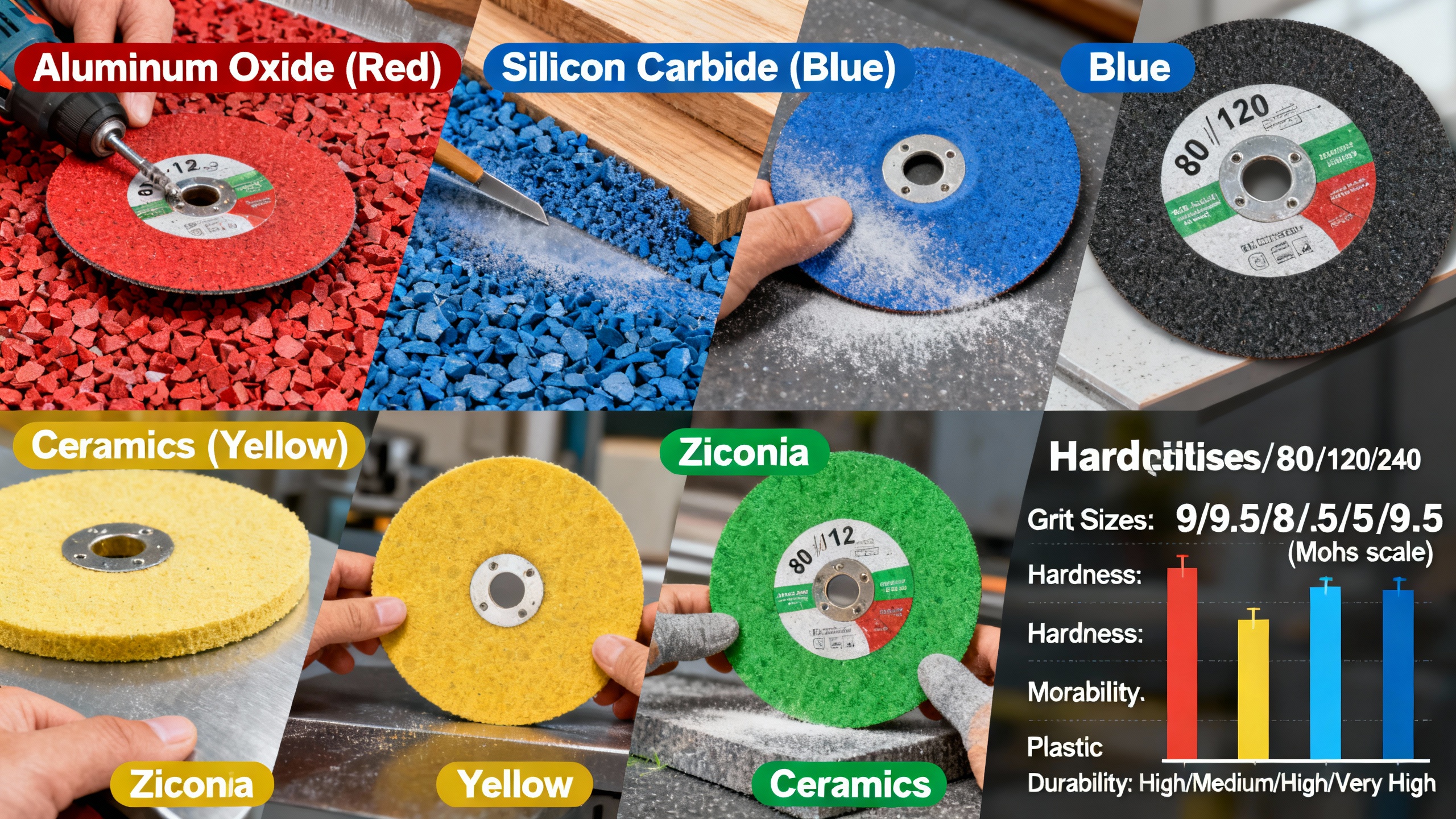
1. Aluminum Oxide (the versatile one)
If abrasives were a family, aluminum oxide would be the older brother—responsible, reliable, and good at a little bit of everything.
Features:
- Medium hardness (9 on the Mohs scale)
- Grains that “renew themselves”—they break apart, creating new sharp edges
- Excellent for mild steel, wood, and plastics
When to use: General-purpose applications where cost-effectiveness is more important than extreme performance. It’s the workshop’s “go-to” abrasive.
Average duration: 2–3 hours of continuous use
Impact on the finish: Good for preparation, fair for final polishing
2. Silicon Carbide (the expert)
Harder than aluminum oxide (9.5 on the Mohs scale), but more brittle. It’s like a precision surgeon—incredible at what it does, but it needs the right conditions.
Features:
- Very sharp grains, almost like microscopic blades
- Excellent thermal conductivity (dissipates heat quickly)
- Ideal for non-ferrous materials, glass, ceramics, and stone
When to use: When working with aluminum, brass, or fiberglass, or when you need a very clean cut without heating the workpiece.
Average duration: 1.5–2 hours (easier to break)
Impact on the finish: Very clean cut, minimal thermal distortion
3. Zirconia (the tough one)
Here we’re entering premium territory. Zirconium alumina oxide is the abrasive that says, “Price? That’s a minor detail. Show me the heavy-duty work.”.
Features:
- Incredible wear resistance
- Keeps the cutting wire sharp for much longer
- It performs well at high temperatures without losing efficiency
When to use: Mass production, where the time required to change a cutting disc costs more than the disc itself. Stainless steel, hardened materials, and jobs that require many continuous hours of operation.
Average duration: 4–6 hours (up to 3 times longer than aluminum oxide)
Impact on the finish: Consistent from start to finish—it doesn't lose efficiency
🟡 The math behind the real cost (that no one tells you about)
Here's the secret that turns choosing abrasives from a “guess” into a science:
Cost-Per-Unit Formula:
Cost per piece = (Abrasive price ÷ Number of pieces processed) + (Changeover time × Labor cost)
I'll give a real-life example from the workshop I mentioned:
Aluminum Oxide:
- Disc: R$ 20
- Quantity: 50 pieces
- Changeover time: 5 minutes (R$, 2 labor hours)
- Cost per unit: R$ 0.40 + R$ 0.04 = R$ 0.44
Zirconia:
- Disc: R$ 50
- Quantity: 150 pieces
- Changeover time: 5 minutes (R$, 2 labor hours)
- Cost per unit: R$ 0.33 + R$ 0.01 = R$ 0.34
Does that seem counterintuitive? The most expensive disc actually costs less per unit. And that’s not even counting the cost of quality: how many units are rejected during quality control due to inconsistent finishes?
🔵 Choose by Application: Your Quick Guide
| Application | Best Option | Why | ESTIMATED Cost per Part |
|---|---|---|---|
| Roughing of mild steel | Aluminum Oxide | Ideal value for the money, adequate performance | R$ 0.30–0.50 |
| Aluminum and Nonferrous Metals | Silicon Carbide | Clean cut, less clogging, less heat | R$ 0.40–0.60 |
| Mass production (steel) | Zirconia | Durability, fewer replacements, consistency | R$ 0.25–0.35 |
| Stainless steel | Zirconia or Ceramic | Resistance to pitting, uniform finish | R$ 0.35–0.70 |
| Extreme precision (molds) | Ceramic | Self-sharpening, superior finish, long life | R$ 0.50–1.00 |
| Tight budget | Aluminum Oxide | Low starting price, availability | R$ 0.30–0.45 |
🟣 The human factor (which technical specifications overlook)
I once met a metalworker who only used aluminum oxide, even when the job called for zirconia. “It’s the only one I know how to use,” he’d say. Until one day, pressed for time, he tried a zirconia disc. His reaction was classic: “Man, where has this been my whole life?”.
The point is: The best abrasive is the one you know how to use well. A ceramic disc in the wrong hands can yield less than aluminum oxide in the right hands.
Here are three things nobody tells you:
- The right pressure: Premium abrasives (zirconia, ceramics) work best with constant pressure, not brute force. Let the material do the work.
- Angle affects performance: A 5-degree difference in the angle of attack can reduce service life by 30%. Use guides and supports; don't rely solely on a “visual estimate.”.
- Speed is the enemy: Higher RPMs don't mean higher productivity. Every abrasive has an optimal speed. If you go beyond that, you're just generating heat and wearing out the disc for no reason.
🔴 Conclusion: Beyond Etiquette
Choose from the types of abrasives It's not just about comparing prices or brands. It's about analyzing:
- Part Material (Ceramic doesn't work on soft plastic)
- Production volume (low volume = aluminum oxide; high volume = zirconia/ceramic)
- Required quality (surface finish? dimensional tolerance?)
- Labor costs (Your time is worth more than the album)
- Cost of Failure (How much does a poorly finished piece cost?)
Remember the story of the garage owner: he had both types because he understood that The right tools for the right jobs. Sometimes, the “cheaper” option is aluminum oxide. Other times, the “cheaper” option is zirconia, which lasts three times as long.
The ideal abrasive is one that disappears while you work. You don't think about it, you don't struggle with it, and you don't have to stop to replace it all the time. It simply does what needs to be done, consistently, from the first grain to the last.
For more information, visit readtogoal.com
Recommended reading: Be sure to check out our article on “Complete Guide to Abrasives: Types, Applications, and Common Mistakes” to expand your knowledge of specific abrasives.
In short:
- Aluminum oxide: Versatile and cost-effective, ideal for general-purpose use
- Silicon Carbide: Specialist in Non-Ferrous Metals and Clean Cutting
- Zirconia: Extreme durability for mass production
- Ceramics: High performance for precision and superior finish
- Selection based on material, volume, required quality, and actual cost per unit
#Industrial Abrasives #Workshop #Tools #Maintenance #Manufacturing
 Portuguese
  English
  Spanish