
Table of Contents
- What Are Superabrasives?
- Difference between CBN and diamond
- When to use each one
- Applications in High-Precision Grinding
- Improvements in dimensional tolerance
- How do they improve Ra/Rz roughness?
- The Importance of Refrigeration
- Errors That Reduce Performance
- When the Investment Pays Off
- Conclusion
CBN and Diamond Superabrasives: When to Use Them?
In conventional machining, there comes a point when increasing the RPM or changing the abrasive simply doesn't solve the problem anymore.
The play keeps getting more exciting.
Tolerance begins to vary.
The finish loses its consistency.
And when you're working with hundredths—or even microns—that quickly becomes a problem.
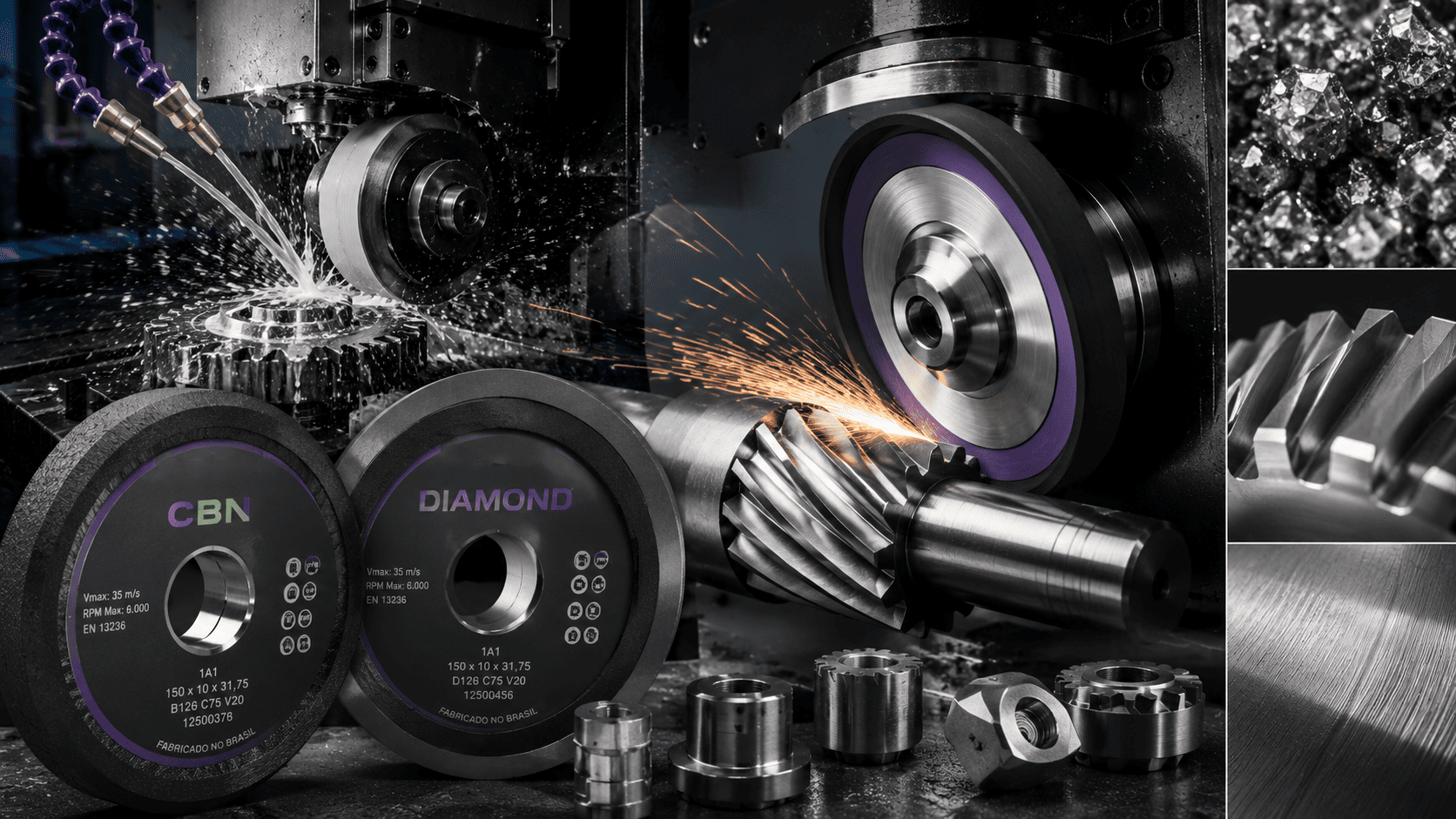
That's exactly where the CBN and diamond superabrasives.
They weren't created just to “cut more.” They were developed to maintain extreme precision, thermal stability, and a consistent finish on materials where conventional abrasives begin to lose their effectiveness.
In practice?
Less thermal deformation.
Greater dimensional control.
Improved surface roughness.
Greater process repeatability.
But there is one important detail:
CBN and diamond are NOT direct competitors.
Each one was designed for completely different materials and applications.
The wrong choice can destroy the tool—literally.
What Are Superabrasives?
Superabrasives are synthetic abrasive materials of extremely high hardness used in high-precision, high-performance applications.
The two main ones are:
- CBN (Cubic Boron Nitride)
- Synthetic industrial diamond
They have superior ability to:
- cut;
- thermal resistance;
- edge retention;
- dimensional stability.
This allows you to work with:
- tight tolerances;
- ultra-fine finish;
- high speeds;
- extremely hard materials.
Difference Between CBN and Diamond
The biggest difference lies in the material of the machined part.
CBN: Ferrous Materials Specialist
CBN is primarily indicated for:
- hardened steel;
- tool steel;
- cast iron;
- hardened ferrous alloys.
This is because CBN exhibits high thermal and chemical stability when in contact with ferrous materials.
In precision grinding, it is widely used for:
- gears;
- axes;
- automotive components;
- bearings;
- tools
Diamond: Ideal for Non-Ferrous Metals
Diamonds are recommended for:
- tungsten carbide;
- technical ceramics;
- glass;
- graphite;
- composites;
- ultra-hard non-ferrous materials.
But there is a critical point here:
Diamond should NOT be used on steel at high temperatures.
This is because a chemical reaction occurs between carbon and iron when heated.
Result:
- accelerated wear;
- loss of performance;
- a drastic reduction in service life.
Suggested sources for technical validation:
Technical Comparison: CBN vs. Diamond
| Criterion | CBN | Diamond |
|---|---|---|
| Ideal material | Ferrous Metals | Non-ferrous metals |
| Thermal resistance | Very high | Discharge |
| Chemical Resistance in Steel | Excellent | Checkout |
| Dimensional accuracy | Excellent | Excellent |
| Surface roughness | Very low | Extremely low |
| Typical Application | Grinding of Hardened Steel | Carbide and ceramics |
| Service life | Very high | Very high |
| Initial cost | High | High |
High-Precision Grinding: Where It Makes a Difference
The CBN and diamond superabrasives They are widely used when the process requires:
- micrometric tolerances;
- extremely low roughness;
- dimensional stability;
- continuous repeatability.
Especially in:
- aerospace;
- automotive;
- toolroom;
- molds and dies;
- medical industry;
- high-speed components.
Improvements in Dimensional Tolerance
In conventional processes, heat is one of the biggest enemies of precision.
The play unfolds.
The profile varies.
Tolerance “spreads.”.
Superabrasives are helpful because:
- remove material more efficiently;
- generate less friction;
- maintain their cutting geometry for longer.
This reduces:
- thermal deformation;
- vibration;
- dimensional variation.
In practice, the process becomes more predictable.
Surface Roughness: Ra and Rz
Here's one of the biggest gains.
Before we continue, let's keep things simple:
- Ra = Overall roughness average;
- Rz = Distance between the peaks and valleys of the surface.
Think of it this way:
The Ra indicates “how smooth” the surface appears to be.
Rz shows “how deep” the largest defects are.
How Superabrasives Improve Ra/Rz
Because the grain maintains a consistent cutting capacity, the finish is more uniform.
This reduces:
- deep scars;
- microcracks;
- superficial burn;
- variations between parts.
The results typically include:
- Lower Ra;
- More controlled Rz;
- a more uniform finish.
In critical applications, this has a direct impact on:
- fence;
- friction;
- fatigue;
- service life of the component.
Refrigeration: That's Where the Secret Lies
Many people invest in superabrasives… and lose performance due to inadequate cooling.
CBN and diamond operate under extremely harsh conditions.
Without proper cooling, you may experience:
- thermal shock;
- clumping;
- glazing;
- burning;
- premature wear.
What the Refrigeration System Needs to Do
The fluid must:
- dissipate heat;
- clean up wood chips;
- lubricate the contact;
- maintain thermal stability.
In precision operations, cooling often has a greater impact on the result than the abrasive itself.
Most Common Types of Refrigeration
| System | Application |
|---|---|
| Conventional emulsion | General Grinding Machine |
| Whole-grain oil | High precision |
| Directed jet | High speed |
| MQL* | Specific Applications |
*Suggested source:
Machining Doctor
Errors That Reduce Performance
Excessive pressure
More pressure doesn't always mean more removal.
With superabrasives, applying too much force can:
- increase the temperature;
- generate vibration;
- compromise the finish.
Incorrect Training
Dressage controls:
- profile;
- grain exposure;
- cutting capacity.
Improper training undermines consistency.
Incompatible speed
Each grinding wheel has an optimal operating range.
Incorrect RPM affects:
- service life;
- roughness;
- thermal stability.
Contaminated fluid
Metal particles in the fluid compromise the finish and increase wear.
When the Investment Pays Off
The CBN and diamond superabrasives They typically justify an investment when the following conditions exist:
High dimensional accuracy requirements
Microns matter.
High cost of rework
Expensive parts leave no room for error.
Continuous production
Greater stability reduces downtime and adjustments.
Difficult materials
Most importantly:
- hardened steel;
- carbide;
- technical ceramics.
Critical repeatability
Robotization and automation depend on this.
When It Might NOT Be Necessary
Not every process requires a superabrasive.
In operations:
- simple;
- manuals;
- low accuracy;
- soft materials;
A conventional abrasive may offer better value for the money.
The most common mistake is to use high-precision technology in a process that doesn't require it.
Safety in Grinding Operations
Superabrasive operations are used in:
- high RPMs;
- high temperatures;
- critical tolerances.
Always wear appropriate PPE:
- face shield;
- safety glasses;
- ear protection;
- compatible gloves;
- exhaust system when necessary.
Please also note:
- Maximum grinding wheel RPM;
- proper balancing;
- manufacturer's specifications;
- integrity of the machine.
So… When Should You Use CBN or Diamond?
The logic is simple:
Use CBN when:
- work with hardened steel;
- grind ferrous materials;
- require high thermal stability.
Use a diamond when:
- work with carbide;
- ceramics;
- glass;
- composites;
- ultra-hard non-ferrous materials.
In both cases, the actual gain appears in:
- tolerance;
- roughness;
- repeatability;
- process stability.
Conclusion
The CBN and diamond superabrasives They are not intended to replace conventional abrasives in every situation.
They are designed to solve problems where extreme precision, thermal stability, and a consistent finish are no longer just a competitive advantage but have become a requirement.
When the process requires:
- tight tolerances;
- low Ra/Rz;
- minimal thermal deformation;
- continuous repeatability;
The superabrasive ceases to be a cost and becomes a process control tool.
And in precision grinding, control is everything.
Want to determine which superabrasive is right for your application? Talk to the technical team at Maverick Abrasivos and evaluate the best setup for your operation.
 Portuguese
  English
  Spanish